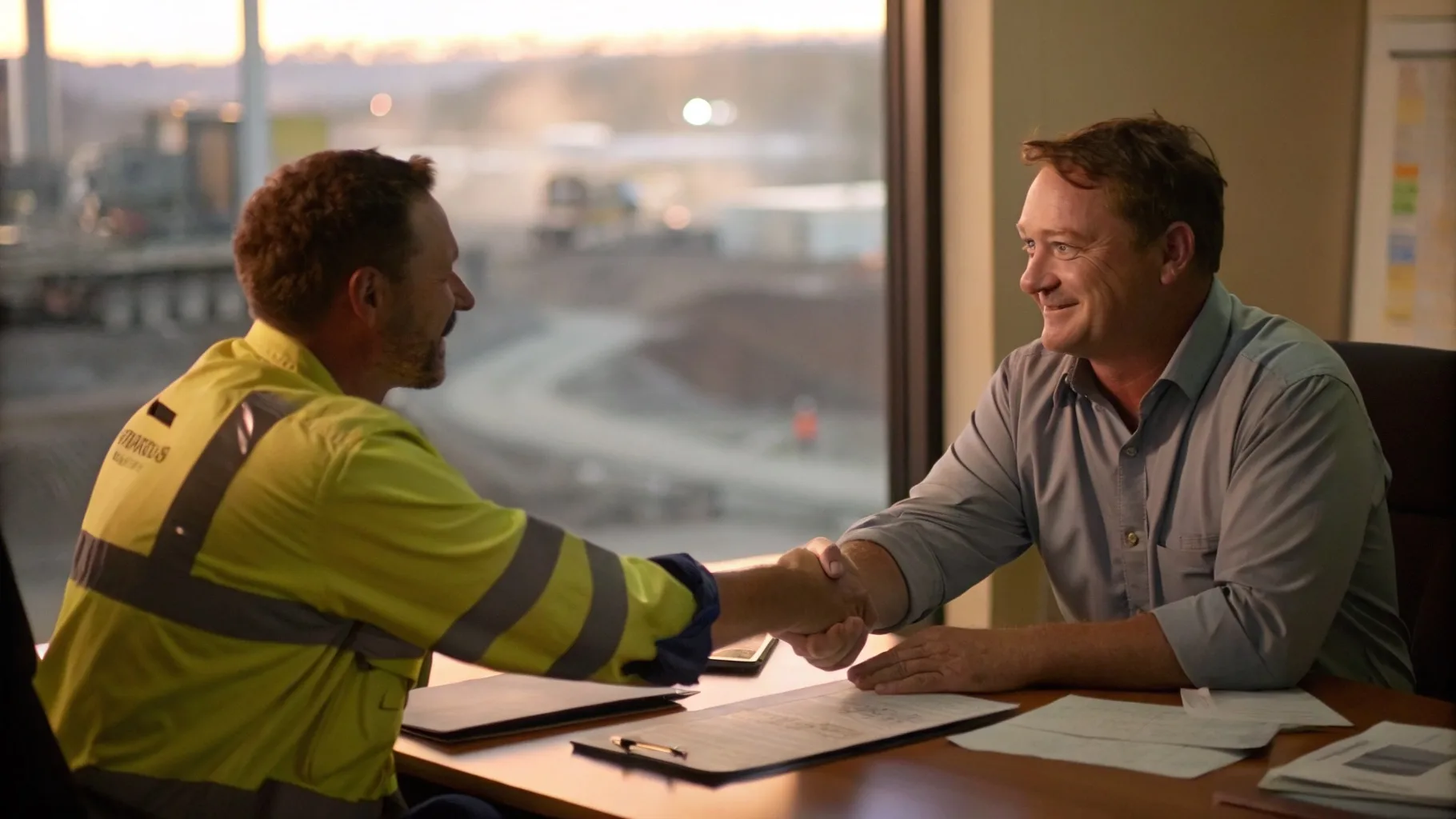
Prepare for your next mining interview with these 17 questions covering safety, equipment experience, teamwork and FIFO life.
We've grouped them by category and provided sample answers you can adapt to your experience. Use real examples from your own work, and keep the details consistent with your resume.
Still preparing your application? See our mining and FIFO resume samples for examples of how to describe equipment skills and safety responsibilities clearly.
Safety Questions (Expect 5-8 of These)
Sample Answer: "During a pre-start inspection on my haul truck, I noticed unusual wear on the front left tyre. It wasn't at the replacement threshold yet, but the wear pattern suggested a potential alignment issue. I reported it immediately through the Take 5 system and the truck was taken out of service for inspection. Maintenance found the steering linkage was starting to wear. By catching it early, we avoided what could have been a serious incident."
Sample Answer: "I'd approach them directly and have a conversation about it — not in an accusatory way, but genuinely checking if everything's okay. Sometimes shortcuts happen when people are under pressure or fatigued. If it was a serious risk, I'd stop the job immediately. Either way, I'd report it through the proper channels afterward. In mining, we're all responsible for each other's safety."
Sample Answer: "Zero Harm isn't just a target — it's a mindset that no task is so important it can't be done safely. It means I have the authority to stop work if something doesn't feel right. It means looking out for my mates, not just myself. And it means going home in the same condition I arrived, every single shift."
Sample Answer: "SLAM stands for Stop, Look, Assess, Manage. Before starting any task, I Stop and take a moment to focus. Then I Look at my work area for hazards. I Assess what could go wrong and how serious it could be. Finally, I Manage those risks — either by fixing them myself, using controls, or escalating if needed. It becomes second nature after a while."
Sample Answer: "Yes. I was asked to operate a loader that had a damaged seatbelt. The supervisor was under pressure to meet production targets, but I explained I wasn't comfortable operating without proper restraint. He wasn't happy initially, but arranged for a replacement machine. The next day he thanked me — said he'd been so focused on the deadline he'd lost perspective."
Experience & Technical Questions
Sample Answer: "I've operated haul trucks for 4 years across two iron ore sites. Started on CAT 785s, then progressed to 789Ds. I'm also competent on water carts and service trucks. In my last role, I consistently achieved 95%+ availability and averaged 180 loads per shift. I'm comfortable with both Wenco and Modular fleet management systems."
Sample Answer: "I follow the same systematic routine every shift — it becomes muscle memory. I start with a walk-around checking tyres, looking for leaks, checking mirrors and lights. Then I check the cab — seatbelt, controls, gauges. I log everything in the pre-start book, even if there's nothing to report. If I find an issue, I don't start the machine until it's addressed or I've got clearance from maintenance."
Sample Answer: "Fatigue management starts before I even get to site — proper sleep, good nutrition, limited alcohol on days off. On shift, I take my breaks properly, stay hydrated, and do the fatigue questionnaire honestly. If I'm struggling, I speak up. I've used the fatigue bay a few times on night shift — better to take 20 minutes than have an incident."
Behavioural Questions (STAR Method)
Situation — Set the scene
Task — What was your responsibility
Action — What you specifically did
Result — The outcome (quantify if possible)
Sample Answer: "During a shutdown, our crew was behind schedule due to unexpected equipment issues. The supervisor asked for volunteers to extend shifts. I coordinated with three other operators to cover additional loads, communicating via radio to optimise our routes. We recovered the lost time and finished the shutdown on schedule. The supervisor mentioned our teamwork in the debrief."
Sample Answer: "I had a disagreement with another operator about the best route to the dump. He preferred one way, I preferred another. Instead of arguing, I suggested we each time our routes over a few loads. Turns out his route was faster in the morning when traffic was different. We ended up sharing that knowledge with the whole crew and everyone's cycle times improved."
Sample Answer: "Early in my career, I misjudged a turn and clipped a berm with my haul truck. No injury or major damage, but it was a near miss. I reported it immediately, even though I was embarrassed. We did a proper investigation and identified that the berm markers were worn and hard to see at night. They were replaced across the whole pit. I learned that reporting incidents, even minor ones, leads to improvements that protect everyone."
Company & Role Specific
Sample Answer: "I've researched [Company]'s safety record and you consistently outperform industry benchmarks. That tells me safety is genuinely part of the culture here, not just a slogan. I've also spoken to a few people who work here and they talk about good equipment, fair management, and opportunities to progress. That's the kind of environment where I do my best work."
Sample Answer: "I want to become an expert operator first — really master the equipment and processes here. Once I've built that foundation, I'm interested in training and eventually supervision. I've enjoyed mentoring new operators in the past and I'd like to develop those skills further. I see this role as the start of a long-term career, not just a job."
Tip: Research the company before your interview. Know what commodity they mine, where their operations are, recent news, and their stated values. Mention specific details to show you've done your homework.
FIFO & Lifestyle Questions
Sample Answer: "Yes, I've worked FIFO rosters before and understand what's involved. I've discussed it with my family and we've got systems in place for communication while I'm away. The roster here actually works well for us because [specific reason]. I'm committed to being reliable and available for every swing."
Sample Answer: "It's not always easy, but we've made it work by being intentional about staying connected. Video calls every evening, shared calendars for the kids' activities, and quality time when I'm home. I've found that when I'm home, I'm really present — not distracted by work. In some ways, FIFO has made us better at communication."
Closing Questions
Always ask questions! Good ones include:
• "What does success look like in this role after 6 months?"
• "What's the team culture like on site?"
• "Are there opportunities for training and development?"
• "What's the next step in the process?"
Make your resume support the story you tell
Turn your real experience into a clear mining or FIFO application. The Rewrite includes a resume and tailored cover letter for A$199.
Get the rewrite — $199